From  Backroads Unearthed‘s Facebook post.
GRAND BAY, ALABAMA: THE LITTLE RAILROAD TOWN WITH LOST SPANISH TREASURE, AN NFL RECORD, AND A BANK THAT BANKRUPTED ITS BUILDERS!
Imagine a small Alabama community where a shipment of fruit trees helped introduce one of the South’s most destructive invasive grasses, two brothers made it to professional football, and a century-old bank eventually housed treasure recovered from a Spanish shipwreck.
Now imagine learning that the construction of that very bank reportedly bankrupted its original owners.
This is Grand Bay, Alabama, a community in southwestern Mobile County with a history far bigger than most travelers along Highway 90 would ever suspect.
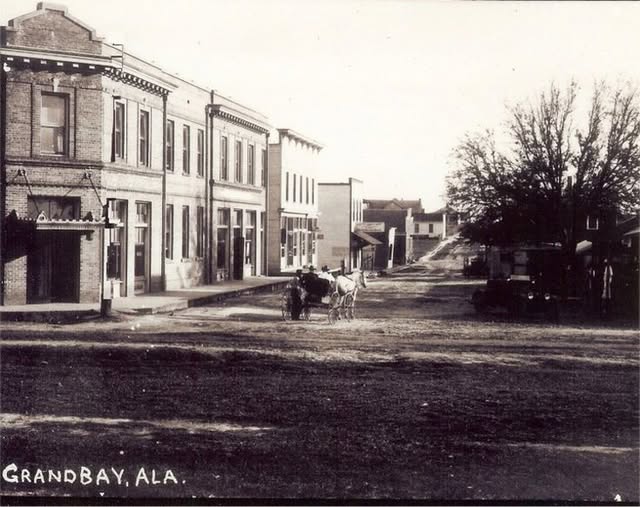
 HISTORIC GRAND BAY: An early photograph labeled “GRANDBAY, ALA.” shows horse-drawn transportation, substantial brick storefronts, and the downtown business district that once served this railroad community. Exact date and original photographer are unconfirmed.
BEFORE THE RAILROAD, THERE WAS THE LAND.
Local historical accounts identify George Cassibry as an early white settler who established a homesite near the headwaters of Franklin Creek in 1853, in the vicinity of today’s Highway 90 and Ramsey Road.
The surrounding countryside was covered with timber, agricultural land, creeks, and wetlands. Before rail transportation transformed the region, waterways connected portions of southern Mobile County with outside markets.
During the closing stages of the Civil War, Union troops under General Gordon Granger moved through the Grand Bay area during operations directed toward Mobile.
Then came the railroad.
In 1870, the New Orleans, Mobile and Texas Railroad was completed through the region. The following year, Grand Bay was laid out for development.
A post office had also been established in 1870.
Suddenly, a rural settlement could ship agricultural products toward Mobile, New Orleans, and distant markets.
THEN CAME THE PROMISE OF A SOUTHERN PARADISE.
In the early 1900s, the Grand Bay Land Company promoted small agricultural properties to prospective buyers, including families from Chicago and other northern communities.
Ten-acre tracts were advertised as opportunities for a comfortable, self-supporting life in the mild Gulf Coast climate.
Pecan trees, citrus groves, and productive farmland formed an attractive picture.
For a time, Grand Bay flourished.
The community developed general merchandise stores, a hotel, a drugstore, a bank, telegraph connections, and even its own newspaper.
Railroad passengers arrived, merchants traded, and agricultural shipments connected local farms to the outside world.
But the Gulf Coast could be unforgiving.
Hurricanes, damaging freezes, and the realities of farming challenged the dream sold to newcomers. Some abandoned their plans and returned north.
Those who stayed helped build the community that followed.
THREE BUILDINGS WOULD TELL AN EXTRAORDINARY STORY.
Around 1907, a commercial building associated with merchant Sewell Freeland stood near the developing downtown.
In 1911, the subdivision known as Schell’s Addition created smaller lots suitable for a more concentrated business district.
In 1912, Albert Freeland, Sewell’s nephew, had a two-story commercial building constructed.
Its first floor served commercial purposes, while rooms upstairs were arranged for boarding-house use.
Then, in 1913, a substantial two-story brick bank building was constructed near the intersection of Freeland and Dezauche.
Here is the astonishing detail.
According to the historical documentation later submitted to the National Register of Historic Places, construction of the bank building bankrupted its original owners.
Yet the building survived.
The Grand Bay State Bank operated there from 1913 until 1929, leaving behind one of the community’s most recognizable historic landmarks.
AND IN 1912, SOMETHING ELSE ARRIVED THAT THE SOUTH IS STILL FIGHTING.
During the era of Grand Bay’s citrus development, imported satsuma trees arrived from Japan.
Among the packing materials was cogongrass.
The invasive grass became established in the region and eventually spread across the Southeast.
Its aggressive underground rhizomes make it extraordinarily difficult to eradicate.
What began as an accidental introduction associated with agricultural imports would become a lasting problem for farmers, landowners, and foresters.
Few communities can claim such an unexpected connection to American environmental history.
WATERMELONS BECAME A LOCAL LEGEND.
Grand Bay’s agricultural reputation eventually became closely associated with watermelons.
By 1929, residents were gathering to celebrate watermelon growers, with festivities that included entertainment and a festival queen.
The celebrations were not continuous through every succeeding year.
But in 1973, the Grand Bay Junior Chamber of Commerce helped revive the tradition, beginning the modern annual celebration.
The Grand Bay Watermelon Festival became a Fourth of July institution, with generations gathering for cold watermelon, music, contests, and community fellowship.
The tradition has continued for more than half a century.
AND THEN THERE WERE THE GRAND BAY TIGERS. 
In 1951, Mobile County High School in Grand Bay began fielding a football team.
The Tigers wore black and gold.
Two brothers who played high school football in Grand Bay would eventually reach the National Football League.
George Hultz played for the St. Louis Cardinals in 1962.
His younger brother, Don Hultz, played professionally from 1963 through 1974 with the Minnesota Vikings, Philadelphia Eagles, and Chicago Bears.
But Don accomplished something even more remarkable.
In 1963, during his rookie season with Minnesota, he recovered NINE opponents’ fumbles.
That remains the NFL single-season record for opponents’ fumbles recovered.
Think about that.
A young man who played high school football in little Grand Bay, Alabama, established a professional football record that has stood for more than six decades!
Back home, the Grand Bay Tigers recorded their winningest football season in 1980, finishing with eight victories.
The school’s football history eventually ended with the consolidation of Grand Bay and Alba into Alma Bryant High School in 1997.
But the Tigers and their athletes remain part of the area’s sporting heritage.
THE POPULATION TELLS ITS OWN STORY.
Grand Bay was never a large incorporated city. It remains an unincorporated community, so comparable town-specific census figures are not available for every early decade.
The recorded population for its census-designated area was:
1980: 3,185 residents
1990: 3,383 residents
2000: 3,918 residents
2010: 3,672 residents
2020: 3,460 residents
The numbers reflect a community that grew through the late twentieth century before experiencing a modest population decline in the following decades.
But Grand Bay’s influence has never been measured by population alone.
THEN CAME A TREASURE STORY ALMOST TOO STRANGE TO BELIEVE.
On August 2, 1993, fishermen working in the Gulf of Mexico discovered silver coins from the wreck of the Spanish vessel El Cazador.
The ship had disappeared in 1784 while carrying a valuable shipment of Spanish silver toward New Orleans.
More than two centuries later, its lost treasure had resurfaced.
And where did some of that treasure end up on public display?
GRAND BAY, ALABAMA.
During the 1990s, the historic former Grand Bay State Bank building housed the El Cazador Museum.
A structure built for ordinary banking transactions became a place where visitors could encounter silver recovered from a centuries-old Spanish shipwreck.
The same building had previously served as Grand Bay’s post office from 1933 to 1975. Its upstairs also served for Masonic meetings and other community gatherings.
Few small-town buildings have experienced such an unusual series of transformations.
SAVING WHAT HISTORY LEFT BEHIND.
On June 28, 1990, the Grand Bay Historic District was officially listed on the National Register of Historic Places.
The designation recognized three contributing commercial buildings dating from approximately 1907 to 1913.
Those surviving structures preserve the footprint of Grand Bay’s original railroad-era business district.
Community preservation efforts later gave the historic bank building another important purpose.
In 2020, it became home to the Grand Bay Library, connecting an old commercial landmark with a new generation of readers.
The library reopened in 2024 following a closure.
Nearby, the former Albert Freeland commercial building also survives as part of Grand Bay’s historic landscape.
And the town’s longstanding watermelon celebration continues to bring families together at Odd Fellows Festival Park.
BUT THE REAL HISTORY GOES DEEPER THAN BUILDINGS.
It lives in the families who planted those early orchards, the railroad workers who handled freight, the merchants who stocked the shelves, and the schoolchildren who grew up cheering for the Tigers.
It survives in old photographs, family stories, forgotten foundations, agricultural relics, and everyday objects that once passed through the hands of Grand Bay residents.
At Backroads Unearthed, we love exploring that side of history through old homesteads, forgotten dumps, bottle discoveries, and former outhouse sites, always with permission. We also love hearing from families who have old photographs, historical knowledge, and stories worth preserving.